Study Guide For Animal Farm Answers
- Free Study Guide For Animal Farm
- Answers For Study Guide Of Animal Farm
- The Glencoe Literature Library Study Guide For Animal Farm Answers
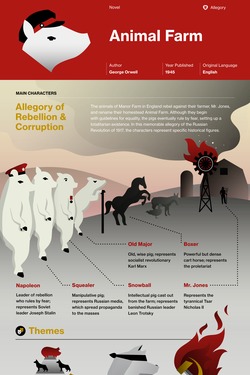
Compare and contrast and. What techniques do they use in their struggle for power?
Does Snowball represent a morally legitimate political alternative to the corrupt leadership of Napoleon? As Joseph Stalin did, Napoleon prefers to work behind the scenes to build his power through manipulation and deal-making, while Snowball devotes himself, as Leon Trotsky did, to winning popular support through his ideas, passionate speeches, and success in debates with his opponent. Snowball seems to work within the political system, while Napoleon willingly circumvents it. Napoleon, for instance, understands the role of force in political control, as is made clear by his use of the attack dogs to expel Snowball from the farm. Despite Napoleon’s clearly bullying tactics, Orwell’s text doesn’t allow us to perceive Snowball as a preferable alternative. Snowball does nothing to prevent the consolidation of power in the hands of the pigs, nor does he stop the unequal distribution of goods in the pigs’ favor—he may even, in fact, be complicit in it early on.
Furthermore, the ideals of Animal Farm—like Orwell’s ideal version of socialism—are rooted in democracy, with all of the animals deciding how their collective action should be undertaken. For any one animal to rise to greater power than any other would violate that ideal and essentially render Animal Farm indistinguishable from a human farm—an unavoidable eventuality by the end of the novella. Though their motives for power may be quite different—Napoleon seems to have a powerful, egocentric lust for control, while Snowball seems to think himself a genius who should be the one to guide the farm toward success—each represents a potential dictator.
Neither pig has the other animals’ interests at heart, and thus neither represents the socialist ideals of Animal Farm. Why do you think Orwell chose to use a fable in his condemnation of Soviet communism and totalitarianism? Fiction would seem a rather indirect method of political commentary; if Orwell had written an academic essay, he could have named names, pointed to details, and proven his case more systematically. What different opportunities of expression does a fable offer its author?
Historically, fables or parables have allowed writers to criticize individuals or institutions without endangering themselves: an author could always claim that he or she had aimed simply to write a fairy tale—a hypothetical, meaningless children’s story. Even now, when many nations protect freedom of speech, fables still come across as less accusatory, less threatening. Orwell never condemns Stalin outright, a move that might have alienated certain readers, since Stalin proved an ally against Adolf Hitler’s Nazi forces. Moreover, the language of a fable comes across as gentle, inviting, and unassuming: the reader feels drawn into the story and can follow the plot easily, rather than having to wade through a self-righteous polemic. In writing a fable, Orwell expands his potential audience and warms it to his argument before he even begins.
Because fables allow for the development of various characters, Orwell can use characterization to add an element of sympathy to his arguments. Especially by telling the story from the point of view of the animals, Orwell draws us in and allows us to identify with the working class that he portrays. Thus, a fable allows him to appeal more intensely to emotion than a political essay might enable him to do. Additionally, in the case of Animal Farm, the lighthearted, pastoral, innocent atmosphere of the story stands in stark contrast to the dark, corrupt, malignant tendencies that it attempts to expose. This contrast adds to the story’s force of irony: just as the idyllic setting and presentation of the story belies its wretched subject matter, so too do we see the utopian ideals of socialism give way to a totalitarian regime in which the lower classes suffer.
Finally, by writing in the form of a fable, Orwell universalizes his message. Although the specific animals and events that he portrays clearly evoke particular parallels in the real world, their status as symbols allows them to signify beyond specific times and places. Orwell himself encourages this breadth of interpretation: while the character of Napoleon, for example, refers most directly to Stalin in deed and circumstance, his name evokes his resemblance to the French general-turned-autocrat Napoleon.
Study Guide Questions – Animal Farm These questions will help you stay on track with the plot as well as build your reading comprehension. Directions: Answer these questions on a separate piece of paper as you read. All answers should be written in complete sentences. Who first introduces the idea of the revolution to the animals? What word does Major use to address the animals? What song does Major introduce to the animals?
Why does Major sing Beasts of England to the animals? What purpose does he want it to serve? Why do the animals succeed in the revolution? What does Mrs.
Jones do as the rebellion begins? What things capture Mollie’s attention? Why do you think the pigs teach themselves to read and write? What are the seven commandments?
What disappears at the end of the chapter? Why do you think Orwell includes this detail, particularly at the end of a chapter? What colors and symbols are on the flag that the animals raise? What maxim do the animals adopt? What purpose does the maxim serve? Do you predict it will have a positive or negative effect as the novel continues? What animals does Napoleon take to rear separately from the others?
Why do you think Napoleon isolates these animals? Where does Mr. Jones spend his time after being expelled from the farm?
What are the names of the two neighboring farmers? What are some of the negative rumors that are spread about Animal Farm?
What do the animals name the battle that occurs in this chapter? Why are the animals, once again, successful against the humans in battle? Who is accused of having contact with a human? How does Napoleon use the sheep to achieve his goals? What benefit does Snowball propose the windmill will provide? What are the arguments against building the windmill?
Why does it prompt such a heated discussion? Why does Napoleon resort to running Snowball off in a violent manner? In what other ways might Napoleon have handled the situation? What does Napoleon’s use of the dogs suggest about the direction in which the operation of Animal Farm is moving? What are Boxer’s two slogans?
What does Squealer mean when he explains that the reason Napoleon opposed the windmill at first was “Tactics, comrades, tactics!”? What does Napoleon say must be done for the farm to survive? Why does Napoleon decide that trade with humans is a necessary evil? How does he explain that to the animals? What is their reaction? How does he ultimately win them over? What does Orwell imply when he writes that people finally began referring to the farm as Animal Farm instead of continuing to call it Manor Farm?
What happens to the windmill? Whom does Napoleon accuse of destroying the windmill? What is the benefit of making Snowball a scapegoat? How does it advance Napoleon’s purposes? How does it appease the other animals? Which two animals have not yet “lost heart”?
What do the chickens have to surrender? According to reports, what is Snowball secretly doing? List two specific accusations made in this chapter against Snowball. What happens when various animals confess to crimes?
Free Study Guide For Animal Farm
Why is “Beasts of England” banned? What words are added (without the animals’ knowledge) to the commandment “No animal shall kill any other animal”?
Why is this important? What is the purpose of Napoleon’s self-imposed sequestering and ceremonial appearances? What is Napoleon’s purpose for inscribing the poem and the portrait of himself on the wall? Is it possible that his purpose might backfire?
Why do the animals initially dislike Frederick? What turnaround occurs regarding Pilkington and Frederick, and what do the animals think of each of them? How does Frederick trick the animals?
What is the irony in the scene where the animals celebrate after the windmill has been blown up? What purpose does this use of irony serve?
For what purpose is the plot of ground that Napoleon has readied for the planting of barley originally intended? What words are added (without the animals’ knowledge) to the commandment “No animal shall drink alcohol”?
What does the unexplainable incident that occurs at the very end of Chapter 8 confirm for readers? Do any of the animals “get it”? Throughout the novel, the animals believe or are led to believe one thing and then are later convinced of another. Why is that and how is that achieved? What does it say about the animals?
About Animal Farm? About society? About Orwell’s beliefs about Soviet Communism? Have your attitudes as a reader changed throughout your reading of the novel? About the pigs?
About various other animals? About Communism?
Answers For Study Guide Of Animal Farm
What injury does Boxer sustain? How does the use of “figures” operate throughout the novel? Why are the young pigs born piebald? What message is sent when bricks are bought and a schoolhouse is built for Napoleon’s offspring?
The Glencoe Literature Library Study Guide For Animal Farm Answers
What is producing the wonderful smell coming from the farmhouse? How is Napoleon served his half gallon of beer every day?
Orwell says that “life nowadays had a greater dignity than it had had before.” In what ways does that appear to be true? In what ways is that, in actuality, false? What does Napoleon’s treatment of Boxer reveal?
Why do the animals believe Squealer when he explains that Boxer was not sent to the knacker? What do the pigs buy with the money that they receive from the knacker? How do you think Orwell wants readers to react to the line, “From somewhere or other the pigs had acquired the money to buy themselves another case of whisky”? Chapter 10 1.
Where is Jones when he dies? When the first windmill is finally completed, how is it used? What is the irony of Napoleon’s statement, “The truest happinesslay in working hard and living frugally”? What mysterious things do the pigs supposedly spend their time working on? What human behavior do the pigs take on in the last chapter of the novel that goes against the first and most sacred commandment of Animalism? Why don’t the animals organize a rebellion of their own to overthrow the pigs? What do you think would be the short term and the long term results if such a rebellion were to succeed?
What causes the fight between the humans and the pigs at the conclusion of the novel? What makes the final scene in the farmhouse so powerful? In Chapters 9 and 10, the farmhouse becomes as much a part of the setting as the rest of the farm itself. What purpose does that serve?