Manual Of Beck Depression Inventory
A common concern about the Beck Depression Inventory, Second edition (BDI-II) among researchers in the area of depression has long been the single-factor scoring scheme. Methods exist for making cross-sample comparisons of latent structure but tend to rely on estimation methods that can be imprecise and unnecessarily complex. This study presents a computationally more efficient method for reproducing a population matrix and uses this method to evaluate competing factor solutions of the BDI-II published in the literature. The results of this study suggest our alternative method can reproduce a population matrix and when used to test various factor solutions of the BDI-II, there is a lack of evidence to suggest any one superior structure.
However, the source of measurement error within some models may help inform the diagnostic utility of the BDI-II. American Psychiatric Association.
Diagnostic and statistical manual of mental disorders ( 4th ed., Text rev.). Washington, DC: Author. C., Meagher, M. W., Norris, M. P., Bramson, R.
Psychometric evaluation of the Beck Depression Inventory-II with primary care medical patients. Health Psychology, 20, 112– 119., Beck, A. T., Steer, R. A., Brown, G. Manual for the Beck Depression Inventory-II. San Antonio, TX: Psychological Corporation.
N., Furlow, C. Evaluation of an approximate method for synthesizing covariance matrices for use in meta-analytic SEM.
Structural Equation Modeling, 13, 153– 185., Bos, S. C., Pereira, A. T., Marques, M., Maia, B., Soares, M.
J., Valente, J.,. The BDI-II factor structure in pregnancy and postpartum: Two or three factors? European Psychiatry, 24, 334– 340., Brouwer, D., Meijer, R. R., Zevalkink, J. On the factor structure of the Beck Depression Inventory-II: G is the key. Psychological Assessment, 25, 136– 145., Brown, M., Kaplan, C., Jason, L.
Factor analysis of the Beck Depression Inventory-II with patients with chronic fatigue syndrome. Journal of Health Psychology, 17, 799– 808., Byrne, B.
Testing for multigroup equivalence of a measuring instrument: A walking through the process. Psicothema, 20, 872– 882., Byrne, B. Structural equation modeling with Mplus: Basic concepts, applications, and programming.
New York, NY: Routledge. M., Steward, S. M., Kennard, B.
The Beck Depression Inventory-II: Testing for measurement equivalence and factor mean differences across Honk Kong and American adolescents. International Journal of Testing, 7, 293– 309., Carmody, D. Psychometric characteristics of the Beck Depression Inventory-II with college students of diverse ethnicity. International Journal of Psychiatry in Clinical Practice, 9, 22– 28., Cheung, G.
W., Rensvold, R. Evaluating goodness-of-fit indexes for testing measurement invariance. Structural Equation Modeling, 13, 287– 321. A two-stage approach to synthesizing covariance matrices in meta-analytic structural equation modeling. Structural Equation Modeling, 16, 28– 53., Chilcot, J., Norton, S., Wellsted, D., Almond, M., Davenport, A., Farrington, K.
A confirmatory factor analysis of the Beck Depression Inventory-II in end-stage renal disease patients. Journal of Psychosomatic Research, 71, 148– 153., Cohen, A. The underlying structure of the Beck Depression Inventory II: A multidimensional scaling approach. Journal of Research in Personality, 42, 779– 786., Furlow, C. F., Beretvas, S.
Meta-analytic methods of pooling correlation matrices for structural equation modeling under different patterns of missing data. Psychological Methods, 10, 227– 254., Genz, A., Bretz, F., Miwa, T., Mi, X., Leisch, F., Scheipl, F., Hothorn, T. Mvtnorm: Multivariate Normal and t Distributions (R package version 0.9-9997) Software. Retrieved from Grothe, K. B., Dutton, G. R., Jones, G.
N., Bodenlos, J., Ancona, M., Brantley, P. Validation of the Beck Depression Inventory–II in a low-income African American sample of medical outpatients. Psychological Assessment, 17, 110– 114., Hammervold, R., Olsson, U. Testing structural equation models: The impact of error variances in the data generating process. Quality & Quantity, 46, 1547– 1570., Henson, R. Effect-size measures and meta-analytic thinking in counseling psychology research.
The Counseling Psychologist, 35, 601– 629., Hoelzle, B. Monte Carlo simulation R code available from EDU 7312–Intermediate Quantitative Statistics: Multiple Regression. Retrieved from Johnson, M. B., Brems, C., Fisher, D. Depression as measured by the Beck Depression Inventory–II among injecting drug users.
Assessment, 13, 168– 177., Kline, R. Principles and practice of structural equation modeling ( 3rd ed.). New York, NY: Guilford. R., Skene, D.
The Beck Depression Inventory II and the Beck Anxiety Inventory in people with intellectual disabilities: Factor analyses and group data. Journal of Applied Research in Intellectual Disabilities, 20, 401– 408., Lopez, M. N., Pierce, R. S., Gardner, R. D., Hanson, R. Standardized Beck Depression Inventory-II scores for male veterans coping with chronic pain. Psychological Services, 10, 257– 263., Mardia, K.
T., Bibby, J. Multivariate analysis. New York, NY: Academic Press. Miles, J., Shevlin, M. A time and a place for incremental fit indices. Personality and Individual Differences, 42, 869– 874., Osman, A., Barrios, F. X., Gutierrez, P.
M., Williams, J. E., Bailey, J. Psychometric properties of the Beck Depression Inventory-II in nonclinical adolescent samples. Journal of Clinical Psychology, 64, 83– 102., Palmer, E. J., Binks, C. Psychometric properties of the Beck Depression Inventory-II with incarcerated male offenders aged 18–21 years.
Criminal Behaviour and Mental Health, 18, 232– 242., Patterson, A. L., Morasco, B. J., Fuller, B.
E., Indest, D. W., Loftis, J. M., Hauser, P. Screening for depression in patients with hepatitis C using the Beck Depression Inventory-II: Do somatic symptoms comprise validity? General Hospital Psychiatry, 33, 354– 362., Quilty, L. C., Zhang, K. A., Bagby, R.
The latent symptom structure of the Beck Depression Inventory-II in outpatients with major depression. Psychological Assessment, 22, 603– 608., R Development Core Team.
R: A language and environment for statistical computing R Foundation for Statistical Computing. Retrieved from Rodriguez-Gomez, J. R., Davila-Martinez, M. G., Collazo-Rodriguez, L.
Factor structure of the Beck Depression Inventory-Second Edition (BDI-II) with Puerto Rican elderly. Puerto Rican Health Sciences Journal, 25, 127– 132., Schreiber, J. B., Nora, A., Stage, F. K., Barlow, E. Reporting structural equation modeling and confirmatory factor analysis results: A review. Journal of Educational Research, 99, 323– 337., Siegert, R.
J., Walkey, F. H., Turner-Stokes, L.
An examination of the factor structure of the Beck Depression Inventory-II in a neurorehabilitation inpatient sample. Journal of the International Neuropsychological Society, 15, 142– 147., Steer, R. A., Ball, R., Ranieri, W. Dimensions of the Beck Depression Inventory-II in clinically depressed outpatients. Journal of Clinical Psychology, 55, 117– 128., Storch, E. A., Roberti, J. Factor structure, concurrent validity, and internal consistency of the Beck Depression Inventory–Second Edition in a sample of college students.
Depression and Anxiety, 19, 187– 189., Thombs, B. D., Ziegelstein, R. A., Pilote, L. A general factor model for the Beck Depression Inventory-II: Validation in a sample of patients hospitalized with acute myocardial infarction. Journal of Psychosomatic Research, 65, 115– 121., Tully, P. J., Winefield, H.
R., Baker, R. A., Turnbull, D. A., de Jonge, P. Confirmatory factor analysis of the Beck Depression Inventory-II and the association with cardiac morbidity and mortality after coronary revascularization. Journal of Health Psychology, 16, 584– 595., Vacha-Haase, T., Thompson, B.
How to estimate and interpret various effect sizes. Journal of Counseling Psychology, 51, 473– 481., Vanheule, S., Desmet, M., Groenvynck, H., Rosseel, Y., Fontaine, J. The factor structure of the Beck Depression Inventory–II. Assessment, 15, 177– 187., Viljoen, J. L., Iverson, G. L., Griffiths, S., Woodward, T.
Factor structure of the Beck Depression Inventory-II in a medical outpatient sample. Journal of Clinical Psychology in Medical Settings, 10, 289– 291., Ward, L.
Comparison of factor structure models for the Beck Depression Inventory-II. Psychological Assessment, 18, 81– 88., Whisman, M. A., Perez, J. E., Ramel, W. Factor structure of the Beck Depression Inventory–Second Edition (BDI-II) in a student sample. Journal of Clinical Psychology, 58, 545– 551., Wilkinson, L. American Psychological Association Task Force on Statistical Inference.
Statistical methods in psychology journals: Guidelines and explanation. American Psychologist, 54, 594– 604., Wilson VanVoorhis, C. R., Blumentritt, T. Psychometric properties of the Beck Depression Inventory-II in a clinically-identified sample of Mexican American adolescents. Journal of Child and Family Studies, 16, 789– 798.
Beck Depression Inventory Manual Pdf
A common concern about the Beck Depression Inventory, Second edition (BDI-II) among researchers in the area of depression has long been the single-factor scoring scheme. Methods exist for making cross-sample comparisons of latent structure but tend to rely on estimation methods that can be imprecise and unnecessarily complex. This study presents a computationally more efficient method for reproducing a population matrix and uses this method to evaluate competing factor solutions of the BDI-II published in the literature. The results of this study suggest our alternative method can reproduce a population matrix and when used to test various factor solutions of the BDI-II, there is a lack of evidence to suggest any one superior structure.
However, the source of measurement error within some models may help inform the diagnostic utility of the BDI-II. American Psychiatric Association. Diagnostic and statistical manual of mental disorders ( 4th ed., Text rev.). Washington, DC: Author.
C., Meagher, M. W., Norris, M. P., Bramson, R. Psychometric evaluation of the Beck Depression Inventory-II with primary care medical patients. Health Psychology, 20, 112– 119., Beck, A. T., Steer, R.
A., Brown, G. Manual for the Beck Depression Inventory-II. San Antonio, TX: Psychological Corporation. N., Furlow, C. Evaluation of an approximate method for synthesizing covariance matrices for use in meta-analytic SEM. Structural Equation Modeling, 13, 153– 185., Bos, S. C., Pereira, A.
T., Marques, M., Maia, B., Soares, M. J., Valente, J.,. The BDI-II factor structure in pregnancy and postpartum: Two or three factors? European Psychiatry, 24, 334– 340., Brouwer, D., Meijer, R. R., Zevalkink, J.
On the factor structure of the Beck Depression Inventory-II: G is the key. Psychological Assessment, 25, 136– 145., Brown, M., Kaplan, C., Jason, L. Factor analysis of the Beck Depression Inventory-II with patients with chronic fatigue syndrome.
Beck Depression Inventory Pdf
Journal of Health Psychology, 17, 799– 808., Byrne, B. Testing for multigroup equivalence of a measuring instrument: A walking through the process. Psicothema, 20, 872– 882., Byrne, B. Structural equation modeling with Mplus: Basic concepts, applications, and programming. New York, NY: Routledge. M., Steward, S. M., Kennard, B.
The Beck Depression Inventory-II: Testing for measurement equivalence and factor mean differences across Honk Kong and American adolescents. International Journal of Testing, 7, 293– 309., Carmody, D. Psychometric characteristics of the Beck Depression Inventory-II with college students of diverse ethnicity.
International Journal of Psychiatry in Clinical Practice, 9, 22– 28., Cheung, G. W., Rensvold, R. Evaluating goodness-of-fit indexes for testing measurement invariance. Structural Equation Modeling, 13, 287– 321.
A two-stage approach to synthesizing covariance matrices in meta-analytic structural equation modeling. Structural Equation Modeling, 16, 28– 53., Chilcot, J., Norton, S., Wellsted, D., Almond, M., Davenport, A., Farrington, K. A confirmatory factor analysis of the Beck Depression Inventory-II in end-stage renal disease patients. Journal of Psychosomatic Research, 71, 148– 153., Cohen, A. The underlying structure of the Beck Depression Inventory II: A multidimensional scaling approach. Journal of Research in Personality, 42, 779– 786., Furlow, C.
F., Beretvas, S. Meta-analytic methods of pooling correlation matrices for structural equation modeling under different patterns of missing data. Psychological Methods, 10, 227– 254., Genz, A., Bretz, F., Miwa, T., Mi, X., Leisch, F., Scheipl, F., Hothorn, T. Mvtnorm: Multivariate Normal and t Distributions (R package version 0.9-9997) Software.
Retrieved from Grothe, K. B., Dutton, G. R., Jones, G. N., Bodenlos, J., Ancona, M., Brantley, P. Validation of the Beck Depression Inventory–II in a low-income African American sample of medical outpatients. Psychological Assessment, 17, 110– 114., Hammervold, R., Olsson, U.
Testing structural equation models: The impact of error variances in the data generating process. Quality & Quantity, 46, 1547– 1570., Henson, R. Effect-size measures and meta-analytic thinking in counseling psychology research. The Counseling Psychologist, 35, 601– 629., Hoelzle, B.
Monte Carlo simulation R code available from EDU 7312–Intermediate Quantitative Statistics: Multiple Regression. Retrieved from Johnson, M. B., Brems, C., Fisher, D. Depression as measured by the Beck Depression Inventory–II among injecting drug users. Assessment, 13, 168– 177., Kline, R. Principles and practice of structural equation modeling ( 3rd ed.). New York, NY: Guilford.
R., Skene, D. The Beck Depression Inventory II and the Beck Anxiety Inventory in people with intellectual disabilities: Factor analyses and group data. Journal of Applied Research in Intellectual Disabilities, 20, 401– 408., Lopez, M. N., Pierce, R.
S., Gardner, R. D., Hanson, R. Standardized Beck Depression Inventory-II scores for male veterans coping with chronic pain. Psychological Services, 10, 257– 263., Mardia, K. T., Bibby, J.
Multivariate analysis. New York, NY: Academic Press.
Miles, J., Shevlin, M. A time and a place for incremental fit indices. Personality and Individual Differences, 42, 869– 874., Osman, A., Barrios, F.
X., Gutierrez, P. Texas rangers media guide 2018. M., Williams, J. E., Bailey, J. Psychometric properties of the Beck Depression Inventory-II in nonclinical adolescent samples. Journal of Clinical Psychology, 64, 83– 102., Palmer, E. J., Binks, C.
Psychometric properties of the Beck Depression Inventory-II with incarcerated male offenders aged 18–21 years. Criminal Behaviour and Mental Health, 18, 232– 242., Patterson, A. L., Morasco, B. J., Fuller, B. E., Indest, D. W., Loftis, J.
M., Hauser, P. Screening for depression in patients with hepatitis C using the Beck Depression Inventory-II: Do somatic symptoms comprise validity? General Hospital Psychiatry, 33, 354– 362., Quilty, L. C., Zhang, K.
A., Bagby, R. The latent symptom structure of the Beck Depression Inventory-II in outpatients with major depression. Psychological Assessment, 22, 603– 608., R Development Core Team. R: A language and environment for statistical computing R Foundation for Statistical Computing.
Retrieved from Rodriguez-Gomez, J. R., Davila-Martinez, M. G., Collazo-Rodriguez, L. Factor structure of the Beck Depression Inventory-Second Edition (BDI-II) with Puerto Rican elderly. Puerto Rican Health Sciences Journal, 25, 127– 132., Schreiber, J.
B., Nora, A., Stage, F. K., Barlow, E. Reporting structural equation modeling and confirmatory factor analysis results: A review. Journal of Educational Research, 99, 323– 337., Siegert, R. J., Walkey, F. H., Turner-Stokes, L. An examination of the factor structure of the Beck Depression Inventory-II in a neurorehabilitation inpatient sample.
Journal of the International Neuropsychological Society, 15, 142– 147., Steer, R. A., Ball, R., Ranieri, W. Dimensions of the Beck Depression Inventory-II in clinically depressed outpatients.
Journal of Clinical Psychology, 55, 117– 128., Storch, E. A., Roberti, J. Factor structure, concurrent validity, and internal consistency of the Beck Depression Inventory–Second Edition in a sample of college students. Depression and Anxiety, 19, 187– 189., Thombs, B. D., Ziegelstein, R. A., Pilote, L. A general factor model for the Beck Depression Inventory-II: Validation in a sample of patients hospitalized with acute myocardial infarction.
Journal of Psychosomatic Research, 65, 115– 121., Tully, P. J., Winefield, H. R., Baker, R. A., Turnbull, D. A., de Jonge, P. Confirmatory factor analysis of the Beck Depression Inventory-II and the association with cardiac morbidity and mortality after coronary revascularization. Journal of Health Psychology, 16, 584– 595., Vacha-Haase, T., Thompson, B.
How to estimate and interpret various effect sizes. Journal of Counseling Psychology, 51, 473– 481., Vanheule, S., Desmet, M., Groenvynck, H., Rosseel, Y., Fontaine, J. The factor structure of the Beck Depression Inventory–II.
Assessment, 15, 177– 187., Viljoen, J. L., Iverson, G.
L., Griffiths, S., Woodward, T. Factor structure of the Beck Depression Inventory-II in a medical outpatient sample. Journal of Clinical Psychology in Medical Settings, 10, 289– 291., Ward, L. Comparison of factor structure models for the Beck Depression Inventory-II. Psychological Assessment, 18, 81– 88., Whisman, M.
A., Perez, J. E., Ramel, W. Factor structure of the Beck Depression Inventory–Second Edition (BDI-II) in a student sample. Journal of Clinical Psychology, 58, 545– 551., Wilkinson, L.
American Psychological Association Task Force on Statistical Inference. Statistical methods in psychology journals: Guidelines and explanation. American Psychologist, 54, 594– 604., Wilson VanVoorhis, C.
R., Blumentritt, T. Psychometric properties of the Beck Depression Inventory-II in a clinically-identified sample of Mexican American adolescents. Journal of Child and Family Studies, 16, 789– 798.
The Beck keeps getting better! You can assess depression with the Beck Depression Inventory®—II (BDI®–II), which is in line with the depression criteria of the Diagnostic and Statistical Manual of Mental Disorders—Fourth Edition (DSM–IV).
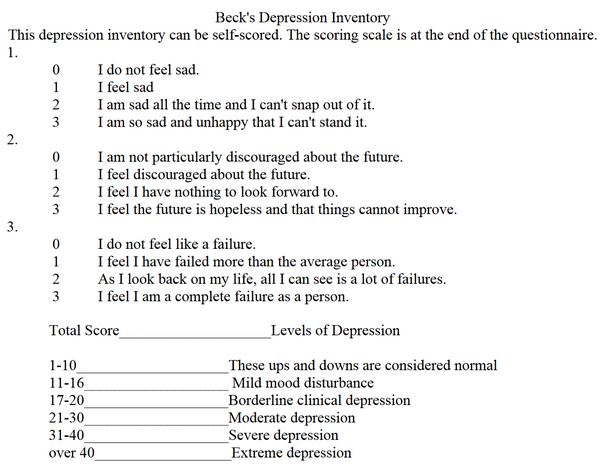
This new edition of the Beck Depression Inventory®, the most widely used instrument for detecting depression, takes just five minutes to complete and is more clinically sensitive than ever. New Items Like its predecessor, the BDI–II consists of 21 items to assess the intensity of depression in clinical and normal patients. Each item is a list of four statements arranged in increasing severity about a particular symptom of depression.
These new items bring the BDI–II into alignment with DSM–IV criteria. Items on the new scale replace items that dealt with symptoms of weight loss, changes in body image, and somatic preoccupation. Another item on the BDI that tapped work difficulty was revised to examine loss of energy. Also, sleep loss and appetite loss items were revised to assess both increases and decreases in sleep and appetite. Time Frame Increased Current DSM–IV guidelines require assessing depression symptoms over the preceding two weeks. The time frame for the response set in the new edition was changed from one week to two to comply. Improved Clinical Sensitivity After testing original and new items on a large clinical sample (N = 500), test developers compared item-option characteristic curves.
The new editions showed improved clinical sensitivity, with the reliability of the BDI–II (Coefficient Alpha =.92) higher than the BDI (Coefficient Alpha =.86). Q-global This test is available on - Pearson's new web-based platform for scoring and reporting. It's accessible anytime, from any computer connected to the Internet. Secure and affordable, this system helps you quickly and automatically organize information, generate scores, and produce accurate, comprehensive reports. Q-global also offers:. 24/7 secure, web-based access.
Portability: Q-global can be used on mobile devices such as a laptop or tablet. On-demand, reliable scoring and comprehensive reporting solutions. Pricing on a per-report basis Interpretive Report This concise report provides useful information such as the client's demographics, a graphical presentation of the client's raw and T scores, a brief interpretation of the client's test scores and a list of items endorsements. Progress Report This report can help monitor a client's progress over time. It graphically displays changes in the client's scores. It is provided at no additional charge.